Most of the GenAI conversations I sat in on during 2024 and 2025 had the same shape. A company buys the licenses. The tools get switched on. Six months later someone asks why nothing measurable has changed, and the answer is almost never the model.
It is that nobody taught anyone how to use it, and the knowledge people actually need is still scattered across wikis, tickets, decks, and the heads of four busy engineers.
So I wrote a book about it.
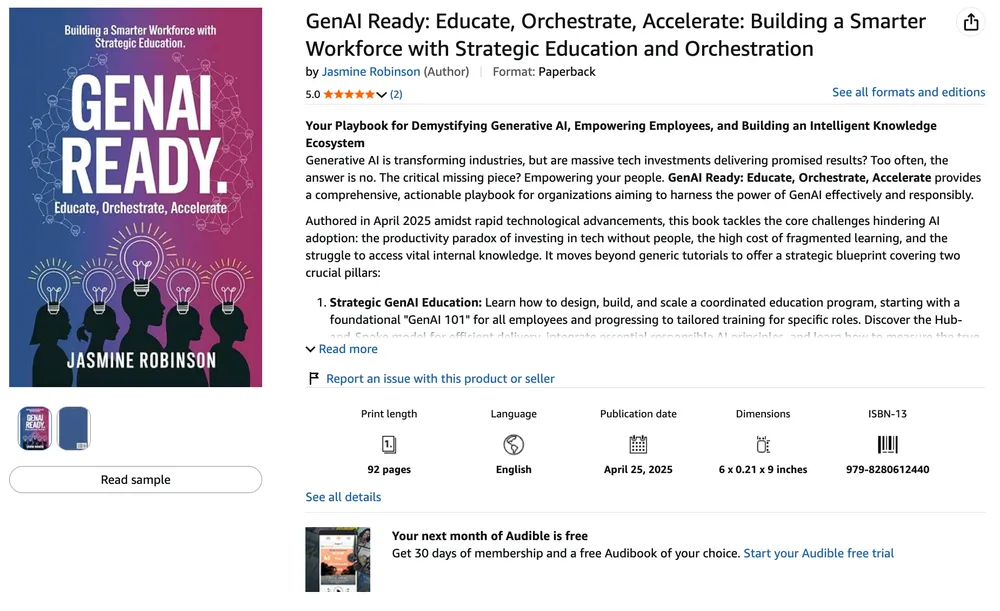
GenAI Ready: Educate, Orchestrate, Accelerate is a playbook for organizations that have already invested in the technology and want to know why that investment is not showing up in the work. It is self-published, available on Kindle and in paperback, and written for the people who usually get handed the rollout: business leaders, L&D teams, IT and AI managers, and HR.
The productivity paradox
The book opens on the gap between spending on AI tools and spending on the people expected to use them. Buying capability is not the same as building it. When an organization funds the first and skips the second, it gets a predictable set of symptoms: fragmented, duplicated learning that costs more than a coordinated program would have; a handful of power users pulling away from everyone else; and a lot of expensive licenses sitting idle.
Pillar one: strategic GenAI education
The first half is about designing an education program you can actually scale.
It starts with a foundational GenAI 101 that every employee gets, with the same baseline, the same vocabulary, and the same ground rules, and then branches into training tailored to specific roles, because what a recruiter needs from these tools has almost nothing in common with what a backend engineer needs.
I lay out a Hub-and-Spoke model for delivering it: a central team that owns the curriculum, standards, and quality bar, with embedded people in each part of the business who adapt it to their own context. It is the structure that keeps a program from either collapsing into one overloaded central team or fragmenting into forty incompatible versions of the same course.
The section also covers responsible-AI principles as part of the curriculum rather than a separate compliance module, and how to measure ROI in a way that survives contact with a finance team.
Pillar two: intelligent knowledge orchestration
The second half is the part I find more interesting, and it is where the book goes past "give everyone a chatbot."
A general-purpose assistant does not know your incident history, your architecture decisions, your internal policies, or why a particular service was built the way it was. So people ask it general questions, get general answers, and quietly conclude the tools do not apply to their job.
The fix is a GenAI Orchestration Layer: an engine sitting between employees and the organization's own verified knowledge, using retrieval-augmented generation (RAG) to pull the right internal source at the moment someone needs it. I walk through the architecture and a phased implementation, because this is not a thing you switch on in one quarter.
Done well, it does something organizations have wanted for a long time and rarely achieved: it breaks down silos and scales expertise, so the answer one team worked out the hard way is available to everyone else without a meeting.
Why these two together
Education without orchestration produces people who know how to prompt but have nothing good to prompt against. Orchestration without education produces excellent infrastructure nobody uses. The book argues they are one program, and the reason so many rollouts underdeliver is that they get funded as two, or as one with the other quietly dropped.
Read it: GenAI Ready on Amazon (Kindle) · Paperback