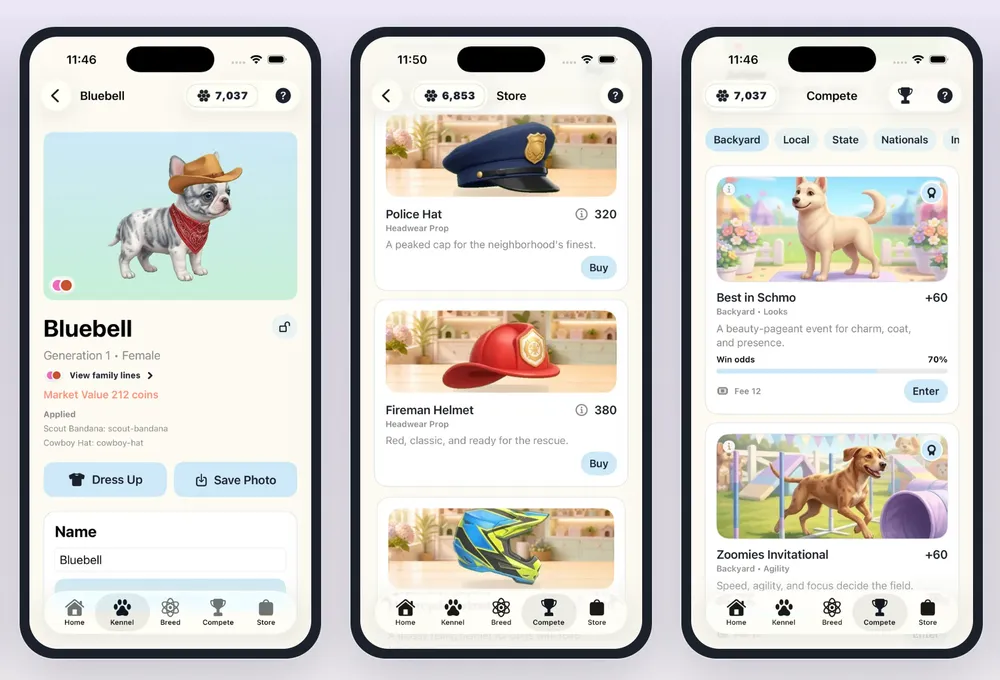
Dog Genome is the first game in my Pet Genome series. I designed it, built it, drew it, balanced it, and wrote the marketing site for it. It is coming soon to the App Store.
You start by rescuing strays: six timed scenes, from a sunny suburb to a snowy village, scooping up puppies before the clock runs out. Then you decide who to keep, who to rehome for coins, and the actual game who to breed with whom.
The genetics are real genetics
Every dog carries traits it does not display. Body, face, ears, coat, and more are inherited through a dominant and recessive model, which means two ordinary-looking parents can carry the same hidden gene and produce something neither of them shows. The rarest looks, such as the fully recessive Poofy body, only appear when both parents pass the gene. You cannot brute-force your way to them. You have to breed toward them across generations, and you have to know what your dogs are carrying.
Which is why there is a DNA Lab. The 23-and-Mutt scanner reveals a dog's hidden carriers, turning the whole game from luck into a plan. Once you can see genotype instead of just phenotype, breeding stops being a slot machine and becomes a project.
On top of the visible traits sit two rarity tiers: silver Sterling, and Prismatic, which the game describes as showing up once in a blue moon. On top of those sit eight inherited stats per dog that feed directly into competition results.
All of that combines into an 800-look Dog-Dex: a catalog of every possible appearance, with coin payouts at collection milestones. Eight hundred distinct, reachable outcomes out of a combinatorial trait system, each one actually obtainable through breeding, is a content-generation and balance problem more than an art problem. It was the hardest thing in the build to get right.
The rest of the DNA Lab
Beyond scanning, the lab is where the late game lives:
- The Sequencer preserves a favorite dog's DNA so you can clone it, meaning your best dog is never permanently lost to age.
- The CRISPR Kit applies a +6 boost to every stat on a clone.
- The Genome Loom is the endgame tool: weave one dog from two or three saved DNA records, choosing exactly which traits and which stats come from where.
There are also four breeding methods at escalating cost, which is really the game's economy in miniature: the Old-Fashioned Way is free and nature decides; the EZ-Whelp (1,000 coins) adds a puppy to the litter; the Pup-O-Matic 3000 (5,000) locks specific traits; and the Franken-Fido Deluxe (10,000) lets you hand-pick every trait and choose which parent each stat comes from. Each tier sells you a little more control over randomness, which is a clean way to give players a coin sink that never feels like a paywall, because none of it costs real money.
Things to do with the dogs you make
- 13 competitions across 7 tiers. Backyard, Local, State, Nationals, International, Universe, and Legends. Cutest Derp, Zoomies Invitational, the Great Tug-of-War, Ironpaw Marathon, Hide and Sniff, Gentle Giant Gala, and more, all scored against the dog's stats.
- Seasonal events. A rotating lineup of limited-time shows, two at a time, cycling through spring, summer, autumn, and winter.
- Five fashion shows across all seven tiers, judged on Poise, Completeness, and Theme Harmony. This is a second scoring system entirely, driven by the 100+ props (jetpacks, Viking hats, shark fins, crowns, cyberpunk visors, hoverboards, fairy wings).
- Family trees tracing every bloodline across generations, plus multi-generation Line Quests.
- A Hall of Fame. Win three titles and podium in the Legends arena and a dog's portrait hangs in your kennel permanently. Its DNA stays available for cloning.
- The Dog Exchange, where you buy and sell, and a Traveling Trader who turns up Friday to Monday paying up to 2.5× for the week's most-wanted pups.
Free, offline, and quiet
Dog Genome is free to play with no ads, ever, and it plays fully offline. No accounts, no in-app analytics, no tracking.
I want to be clear that this was an engineering decision as much as an ethical one, and it made the build harder rather than easier. There is no server to fall back on. Every dog, every preserved DNA record, every family tree spanning generations, every Hall of Fame entry, and the entire Dog-Dex completion state lives on the device and has to stay internally consistent forever, including when a dog is cloned from a record whose parents were rehomed forty generations ago. Referential integrity across an unbounded, user-generated pedigree graph, with no backend to repair it and no telemetry to tell me when it broke, is a genuinely interesting persistence problem.
It also means I had to be right the first time. With no analytics I cannot watch where players stall, and with no server I cannot hotfix balance. Everything had to be tested until I trusted it.
Why this is on a portfolio site
I build developer education and GenAI enablement programs for a living. Shipping a game by myself is not a career change. It is the same muscle in a harder gym.
A solo game means there is nobody to hand the unglamorous parts to. I scoped it, designed the systems, built them, made the art, tuned an economy so that 10,000-coin tools feel earned rather than gated, wrote the copy, built the site, and took it through App Store submission. When a project has one person on it, every shortcut is visible in the finished thing, and every decision is traceable to one person's judgment. That is a fairly honest way to be evaluated.
Dog Genome is coming soon to the App Store. See the full game at petgenomegame.com →
Cat Genome is on its way.